How it works
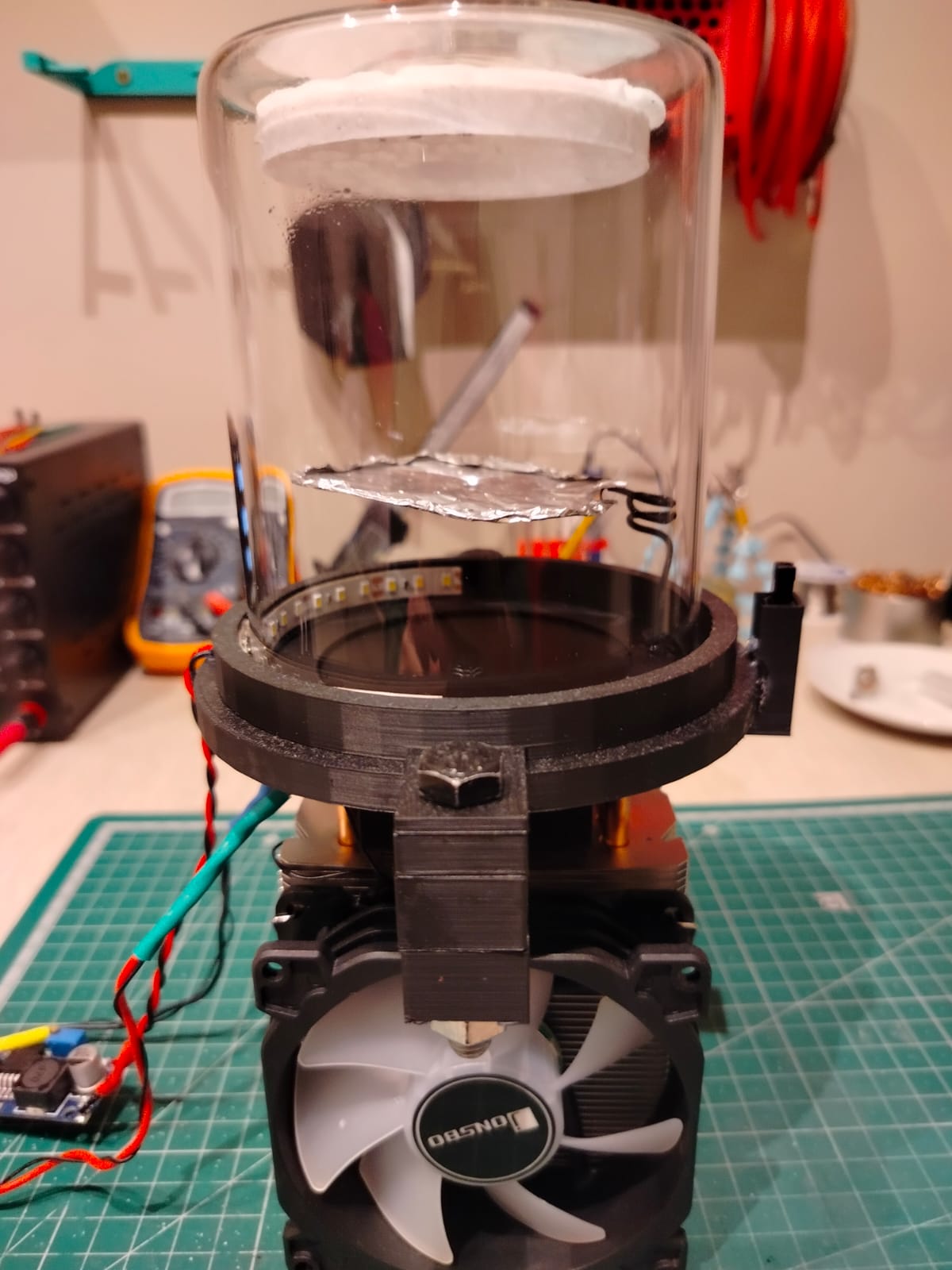
A cloud chamber works by creating a layer of supersaturated isopropyl alcohol vapor just above a freezing surface. In this specific zone, the air is so packed with vapor that even a tiny disturbance triggers instant condensation. Ionizing radiation provides exactly that kind of disturbance.
When a charged particle passes through, like an alpha particle from natural decay or a cosmic ray muon, it knocks electrons off the air molecules in its path. These ions act as tiny seeds for the alcohol vapor to condense around. The result is a visible white trail that looks exactly like the contrails left by high-altitude aircraft.
The secret is maintaining a massive temperature difference. The top of the chamber stays warm so the alcohol can evaporate from a felt pad, while the bottom is kept extremely cold. This gradient is what creates the sensitive supersaturation layer where the magic happens.
Key components
To get the base cold enough, I used a cascaded TEC2 Peltier module. This is essentially two Peltier stages stacked together. While a single stage usually can't reach the necessary temperatures, cascading them allows the cold side to drop well below -30°C, which is the sweet spot for reliable particle tracks.
I mounted a high performance CPU heatsink on the hot side to keep things stable. It is the same kind of cooling hardware you would find in a gaming PC, and it works perfectly for managing the thermal load here.
I also ran into a common issue: ambient ions in the air can create "fog" that hides the clean tracks. My solution was to build a piezoelectric high-voltage generator using the igniter from a kitchen lighter. By connecting it to an aluminium foil mesh, I created a weak electric field that sweeps away background ions and keeps the sensitive layer clear for actual radiation events.
The power delivery is simple. I run 12V directly to the fan and the Peltier module, while a buck converter steps that down to 5V to power the LED strip that illuminates the chamber from the sides.